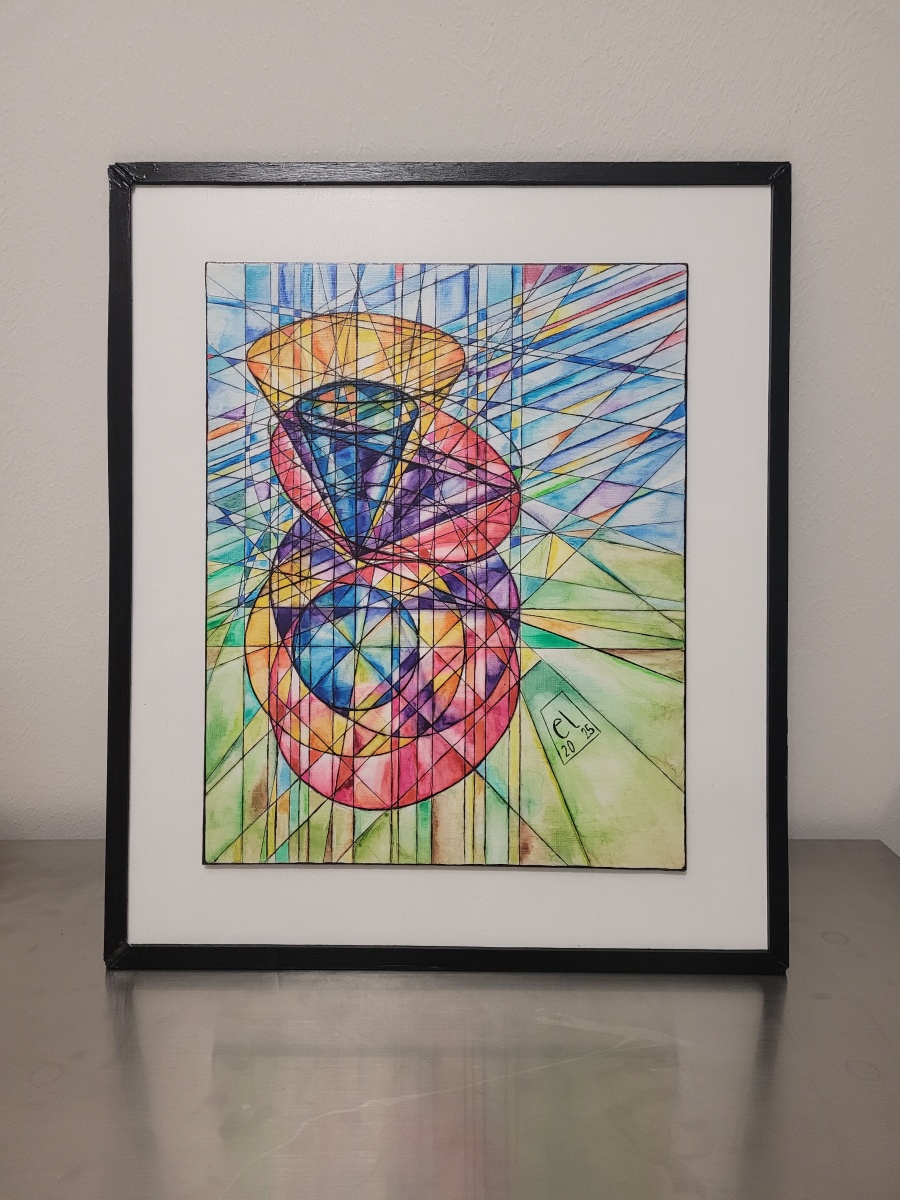
I have always loved the physics of the gyroscope. There are so many different mathematical / conceptual / geometrical ways to capture the same thing. Lots of interesting ellipsoids and cones are waiting to be drawn!
Here, I am visualizing the motion of a gyroscope free of external forces, involving three cones, following Louis Poinsot.
I am using my decades old physics education – and books, in German. The best concise web reference I could find is this one, also in German. Enjoy my interpretation of Spurkegel, Polkegel and Nutationskegel! My ignorance of the proper English terms is showing up in the image file names. Originally, I called the artwork Poinsot, Prolate, figuring that a prolate gryoscope is a fat one. But the fat one is oblate, and Poinsot, Oblate does not sound that good to me.
So, this is the Making Of Poinsot’s Dancing Cones. See me “meditating upon mathematical physics geometrically”!
I am constructing the cones as an axonometric projection, from the view from the top and the view from the side. My drawing surface of choice this time is canvas board, additionally gessoed and sanded to make it smoother. It feels good to move a pencil over it – it is gliding in silence! No scratching!
As the drawing progresses, I start adding a bit of watercolor pencil. This is also to keep track of which line should connect to what. The photo shows the stage before I activate it with water:

Having constructed 3 of 4 cones, I am adding water. Moving around puddles on the board, I realize that a credible cones needs to have “reflections” that are bounded by straight lines.
And finally – before I lose track of the construction – I am drawing the fourth cone.
The red and the violet cone are instances the same cones, at different points of time. This cone embraces the blue one and rolls around / along it. The symmetry axis of the red/violet cone traces out the yellow cone. Where the red/violet and the blue cones meet, you find the axis of rotation that changes with time.
The red/violet cone is wide and it is embracing the blue one because the related gyroscope would be “fat”, with an oblate ellipsoid representing its principal moments of inertia.

At this stage, I do not think about the physics. All the shapes dissolve. This is just a tesselation of a surface. And again, I envisage it as being made from stained glass.
So I touch each of the cells once more, and move puddles of water again. The advantage and the disadvantage of the canvas board is how non-absorbent it is. You can lift off the color again and again.
I am also using watercolor markers in addition to watercolor pencils, and I am re-tracing all the lines with ballpoint pen.

Letting go of all the physics, math, and geometry – just immersing myself on color, I am turning the background into stained glass, too:

The canvas board is a little bit warped, but I can fix this by applying water to the backside (and pressure).
How to finally present it? I build a custom frame – a first rough prototype for how I want to frame my art on thicker boards!
I want the canvas board to “float” in front of a white board, no glass, nothing (not even a mat) overlapping. The outer black frame should be rather thin.
I’ve varnished the canvas board with glossy spray coating, painted the sides black and added a very thin “hairline” black frame directly on the canvas board. I want to see these black edges, hence the idea of placing the drawing on top of another board.


This prototype is fully made of foam board!


Leave a Reply