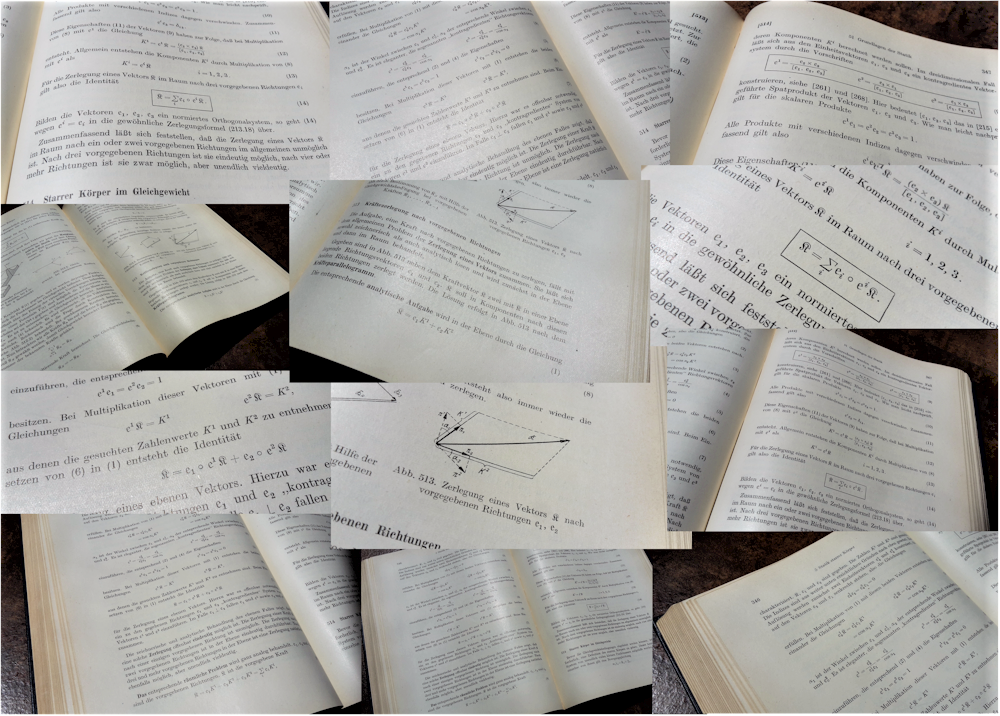
A recent migration of (some of my) domains made a link on Wikipedia go into the void of a 404. It was a brief, German article on another – now extinct – German website of mine, linked by the article on Wilhelm Macke.
In order to keep it alive though, I am copying the article over here, translating it. I will create a redirect so that my original, odd non-Wordpress URL quoted by Wikipedia will hopefully work.
I add the German version below the English one (and I hope that WordPress/Google etc will not penalize me for doing so).
Prof. Macke was my theoretical physics professor decades ago, and he had been a student of Werner Heisenberg and Max Planck.
Originally written in 2013.
~
Translated version
Add a quantity without damage … throw the operator over: idioms like are still lingering in my mind (and they cannot quite be translated without loss). I also find them in his books, a six-volume series of textbooks on theoretical physics. When I was a student, I had used a selection of sections copied from these books.
I found these books again in an online antiquarian bookshop in 2010 and ordered them immediately.
Theoretical Physics by Wilhelm Macke:

Prof. Wilhelm Macke still taught theoretical physics, not yet computational physics. His mathematical abbreviations, concise syntax reduced to the minimum – called Mackematics by students – were legendary.
He was of the opinion that symbolic notation should not only speed up your writing proofs, nor was it for the sake of elegance only. Condensed notation led to new insights; you learned how to grasp the underpinnings of a phenomenon in the physical world in a new way. I learned to think in his mathematical idioms. Perhaps the most valuable take-away from my studies of physics (even though I became an experimental physicist).
I can clearly remember his exposition of one of the simplest differential equations: motion under the influence of a spring, under a force proportional to the elongation of the spring. Without solving the equation, he demonstrated how the curvature of the path was determined by the force – at any time and in any place – in a position which in turn was dependent on the motion.
His writing was a little shaky, but the structure of the blackboard was flawless. Prof. Macke was always perfectly prepared; he used notes that seemed to have been in use for 20 years: small pieces of paper that had been folded multiple times.
The structure of his books also reflects his methodology: logical structure, compact repetitions and carefully selected examples. The Feynman Physics Lectures were published almost the same year as his work, also on my list of personal physics classics. The differences in presentation could not be greater – perhaps it is different personal styles, perhaps indicative of European versus American style (in the 1960s).
Macke carefully structures his explanations, and you can follow him well if you heed the advice he mentions in the foreword to the first volume: don’t skim what is supposedly well-known and simple. His explanations are elegant, but modest – without putting on a show.
He did not expect brilliancy from his students, but solid cooperation, ‘reading with a pencil in hand’. Just like Feynman said in the foreword of his Lectures, Macke mentions that such advice is heeded by precisely those students who least need it.
In his office, a picture of his doctoral supervisor Heisenberg hung on the wall and the legendary cigarette smoke wafted along the ceiling. Macke was supposedly able to smoke a cigarette in the estimated 30m between leading to the physics lecture hall.
I did not write my MSc and PhD theses at his institute. From a professional point of view, I do not regret it. But I might have learned more about a piece of physics history: what it was like to come to the West as a scientist during the Cold War. How a student of Heisenberg saw the replacement of German dominance in physics by the USA. Or about cultural change in research – from quiet research to quarterly reports and pressure to raise money through grants.
Prof. Macke was the second examiner for my diploma (MSc) examination, but unfortunately he was no longer alive when I completed my PhD. Since 1992 there has been an award honoring outstanding master theses at the University of Linz that bears his name and is financed by a foundation established from his estate.
~
German version
'Eine Größe ohne Schaden hinzufügen'… 'den Operator hinüberwerfen': Formulierungen wie diese klingen immer noch nach in mir und ich finde sie auch in seinen Büchern, einem sechsbändigen Gesamtwerk zur Theoretischen Physik. Ich habe diese Bücher 2010 in einem Online-Antiquariat gefunden und sofort bestellt:
Prof. Wilhelm Macke unterrichtete noch Theoretische Physik, nicht 'Computational Physics'. Seine auf das Minimum reduzierten mathematischen Kürzel – die Mackematik – waren legendär. Er vertrat die Meinung, dass die symbolische Schreibweise nicht nur im Sinne einer Arbeitserleicherung verwendet werden sollte oder um ihrer Eleganz Willen. Die verdichtete Schreibweise ermöglichte auch neue Einblicke in die Struktur der beschriebenen Phänomene. Ich lernte, in seinen Formalismen zu denken und diese Erkenntnisse waren vielleicht das Wertvollste, das ich aus meinem Studium mitnehmen konnte.
Ich kann mich deutlich erinnern an seine Erläuterungen zu einer der einfachsten Differentialgleichungen: der Bewegung unter dem Einfluss einer zur Auslenkung proportionalen Federkraft. Ohne die Gleichung zu lösen, führte er uns vor Augen wie die Krümmung zu jeder Zeit an jedem Ort durch die Kraft bestimmt wurde, die dann ihrerseits wieder abhängig von der Bewegung ist.
Seine Schrift war etwas zittrig, aber die Struktur des Tafelbildes ware makellos. Prof. Macke war immer perfekt vorbereitet; er verwendet Notizen, die den Eindruck machten, schon 20 Jahre in Verwendung zu stehen: Kleine Zettel, die unglaublich oft gefaltet waren.
Auch die Struktur seiner Bücher spiegelt seine Methodik wider: Logischer Aufbau, kompakte Wiederholungen und sorgfältig ausgewählte Bespiele. Fast im gleichen Jahre wie sein Werk sind die Feynman Physics Lectures erschienen, auch auf der Liste meiner persönlichen Physik-Klassiker. Die Unterschiede in der Präsentation könnten nicht größer sein – vielleicht sind es verschiedene persönliche Stile, vielleicht sind es Sinnbilder für mitteleuropäischem und Amerikanischen Stil.
Macke baut seine Erklärungen mit Bedacht auf, man kann im gut folgen, wenn man seine im Vorwort des ersten Bandes erwähnten Ratschläge beachtet und nicht zu schnell über angeblich Bekanntes und Einfaches hinweg liest. Seine Ausführungen haben ihre eigene Eleganz, auch ohne Knalleffekt und Zirkuskunststücke.
Er erwartete nicht Genialität von seinen Studenten, aber solide Mitarbeit, 'Lesen mit dem Bleistift in der Hand'. Genau wie Feynman in dessen Vorwort erwähnt auch Macke, dass solche Ratschläge aber genau von denjenigen Studenten beachtet werden, die sie am wenigsten brauchen würden.
In seinem Büro hing an der Wand ein Bild seines Doktorvaters Heisenberg und an der Decke waberte der legendäre Zigarettenrauch. Angeblich war Macke fähig gewesen, auf den geschätzt 30m zwische zwei Türen zwischen Gang und Physikhörsaal eine Zigarette zu rauchen.
Ich habe meine Diplomarbeit nicht an seinem Institut verfasst. Aus fachlicher Sicht bereue ich es nicht. Aber ich hätte vielleicht mehr erfahren über ein Stück Physikgeschichte: wie es war, zu Zeiten des kalten Krieges als Wissenschaftler in den Westen zu kommen. Oder wie ein Schüler Heisenbergs die Ablöse der Deutschen Dominanz in der Physik durch die USA sah und den kulturellen Wandel in der Forschung – vom vergleichsweise unbehelligten Forschen zu Quartalsberichten und Rechtfertigungsdruck.
Prof. Macke war Zweitprüfer bei meiner Diplomprüfung, bei meinem Rigorosum war er leider nicht mehr am Leben. Seit 1992 gibt es einen Preis für Diplomarbeiten an der Uni Linz, der seinen Namen trägt und von einer aus seinem Nachlass gegründeten(*) Stiftung finanziert wird.
~
The photo above is from 2013 as well. It sticks out like a sore thumb among my art – or so I hope! I might get back to this and do his elegant books more justice. I had tried a bit actually, more recently – remembering how he introduced covectors:

~
And yes, I have no right anymore to share my spirited anti-linkrot manifesto! I let many of my URLs go. I felt good.
Related (to my theoretical physics nostalgia, not to me killing URLs) – my reflections on leaving academia: The Dark Side Was Strong in Me.
~


Leave a Reply