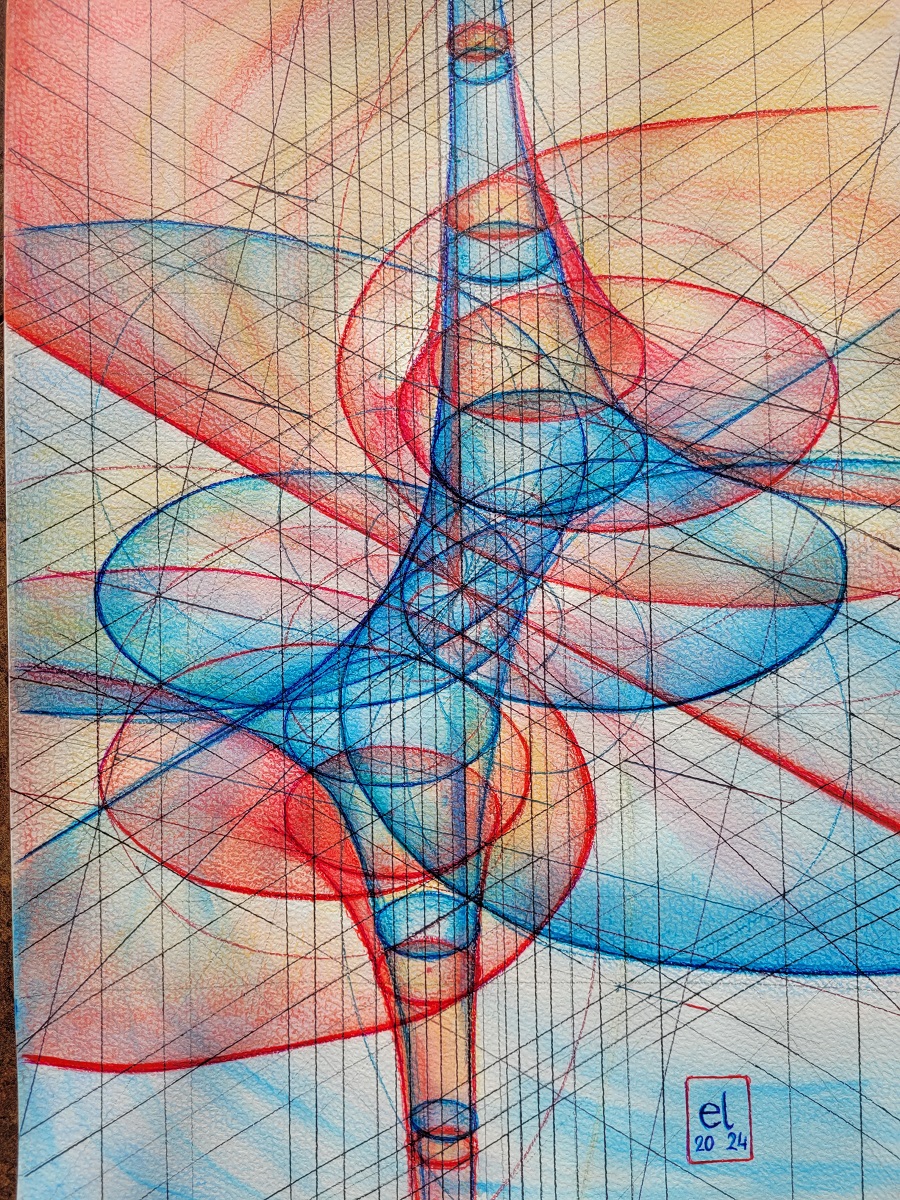
I see towers.
I see trumpets.
Reaching up to infinite heights. Becoming infinitely thin.
Widening at the base. Expanding to a circle of infinite radius. Expanding to a line.
I am talking about mathematical functions. This is the way I see them!
I’ve recently started to create geometric drawings (axonometry) of mathematical functions, the same ones I usually tackle with code. One could say it does not make sense to painstakingly draw what code could create quickly. For me, the interesting thing is to grasp these functions on a different, more intuitive level – intuitive compared to mentally processing mathematical formulae or casting it into computer code.
Having manipulated mathematical expressions and having written code for many years I have rediscovered descriptive geometry, as sort of a third language – in addition to math or code – to say the same things. I am also fascinated by the little math puzzles that pop up when I create these drawings, and which require a completely different approach compared to calculations or programming.
I am usually drawing them at least three times, until I am somewhat satisfied. The journey is the reward anyway!
Here are my first attempts at taming two favorite functions of mine – often already used in my creative coding art. I called them Reality and Imagination as these are two “towers” or “trumpets” that represent real and imaginary part of the complex function 1/z. Grand words, but you also describe them as: Stack circular rings upon each, ring diameter decreasing reciprocally with height, align along the circumference. Then flip over, and then rotate by 90 degrees.
With code, I had rendered the circles as simple lines, and most recently as blue and yellow metallic tubes:

Circles become ellipses when projected to the drawing plane; that seems to be easy. But I am currently using “small” A4 watercolor paper, and so the 2D projections overlap greatly with the 3D axonometric image.
So, here are work-in-progress photos of two versions of the Reality and Imagination towers, with slightly differently positioned 2D projections and different sizes of the circles. The version where I colored the ellipses / circles already was the first, rougher one – and I will test something bolder with that one. The other one will maybe become a more delicate drawing. I also take a look at the code-generated structures – not for comparing details, but to get the overall look right.

The challenge will be to convey the spirit of this trumpet-like surface without of course create all the giant circles…. as moving closer to the origin of the vertical axis, the radii of the circles get larger and larger, and finally the straight axis is the “circle with infinite radius”. The overall shape of each function looks a tower that gets infinitely large at the base and its version obtained by “flipping it over”, extending to minus infinity.
Watercolor drawings created by architects speak to me. Their way of depicting buildings, especially has likely inspired me in an indirect way. My functions look like futuristic buildings or spaceships to me.

The drawing is an exact geometric drawing based on the projections from above (circles – clover-leaf in the center of the paper) and from the side (circles seen as lines). Then I construct the axonometric projection. Having drawn a bunch of circles it starts getting really crowded. Then I try to get the overall enveloping shape the surface somewhat right – and then I also look at the digital version as a cross-check.
The contour lines of my buildings – balconies or galleries? – are circles whose radii decrease reciprocally with height. They are aligned along one point of the circumference. The towers of reality and imagination can be rotated into one another. There are two intersecting lines between the real and the imaginary tower: the vertical axis and one line that looks like the reciprocal (1/x) function, in a plane right in between the xz- and the yz-axis.
It is all highly symmetrical, and in addition I picked a view that conserves the “symmetry” of x and y also “in the third dimension. Sometimes, this makes drawing easier. Sometimes, it makes it more confusing.
I have picked the colors intuitively, but now I see: Red pill versus blue pill :-)
The bold version is still awaiting its final touches, but I call the timid one finished. Reality and Imagination for real – from orthographic projections:

~
Related:
Series Reality and Imagination – created by code. Towers/trumpets seen from more than ten viewpoints, rendered as metallic tubes.
More blog posts about the math and physics background, plus poetry:
Solid and Ethereal. Reality and Imagination.
Field Lines and Potentials – Reality and Imagination Reloaded
Why am I doing this? I am still exploring:

Leave a Reply