Tag: Descriptive Geometry
-

Geometry of the Motion of a Free Prolate Gyroscope (and the Power of Magnets)
How should I spin the story of the gyroscope this time? Imagine, you have a wonderfully crafted elongated ellipsoid from wood (shaped like a rugby ball). You built some apparatus that make it spin fast about its major axis. Probably you can make it spin with your bare hands – or you ask a tentacled…
-
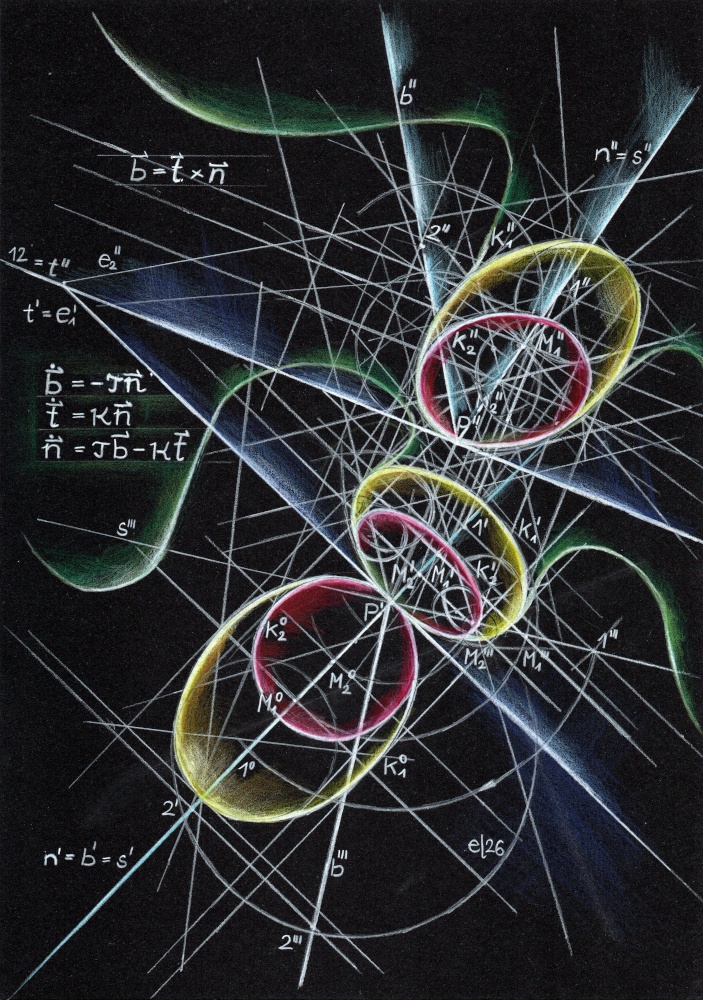
Osculating Circles Revisited
Every squiggly line could be an image of the meandering trajectory of a particle. At each instant, the path has a direction and a curvature. Curvature can be represented by the circle that fits the curve best – the osculating circle. In a two-dimensional world, the osculating circles would lie flat in the same plane…
-
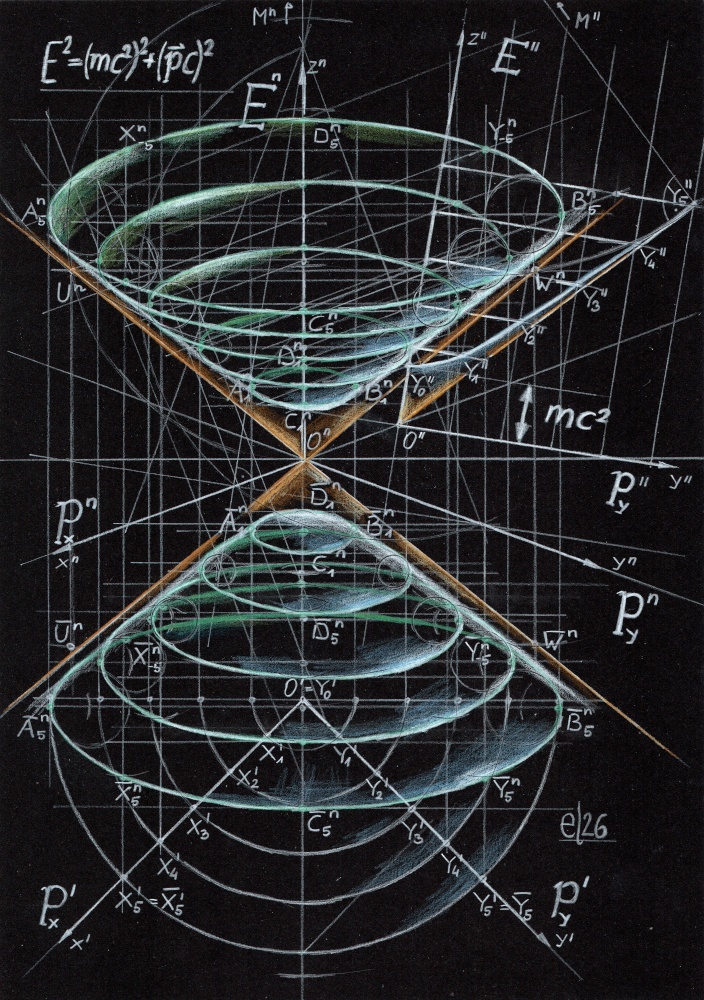
Mass Shell
Space and time are rotated into each other. Momentum and energy are as well. This rotation in four dimensions is of an unusual, hyperbolic kind. Which is the source of all so-called paradoxa in special relativity. Best to avoid thinking of clocks, rulers, trains, and observers. Just stick to the geometry. When a classical particle…
-

Dare to Be Negative!
Do you remember analog photo negatives? I still have some, tucked away deep in the archives. I always found them eerie and uncanny. Humans turned into zombies with black teeth. Burnt orange, weird cyan and violet everywhere. But what did I expect? We don’t have an intuition for addition or subtraction of colors. Would you…
-

Circles to Lines (2026)
Circles and lines – that sounded manageable. So, this was one of my first attempts at reviving descriptive geometry. A circle on a sphere is projected into a circle in the equatorial plane under stereographic projection. But if the source circle contains the North Pole, the projection ray in this point becomes tangent to the…
-

Drawing With Code
What does it even mean? I see two main ways of drawing with code: 1) going for a representation of a thing you have in mind, or 2) using an algorithm and elements of randomness to surprise you. Representational I have code-drawn Lissajous curves with code – from a picture in mind before I started.…
-
On Descriptive Geometry
I keep forgetting I am writing for an international audience here! Having referred to Descriptive Geometry (DG) often, I doubt that everybody associates similar mental images with it. Anybody remembering the trace of a plane, for example? Learning about the history and culture of Descriptive Geometry, I realize it is rooted in a European tradition…
-

Rolling Not Slipping – Story of a Twirling Ellipsoid
I can’t help it – I use the first title that pops into my mind! “Rolling, not slipping” is the punchline of a mathematical argument used in classical mechanics, in the theory of the motion of a gyroscope. But I am not going to do it justice in this blog post (apart from a math…
-
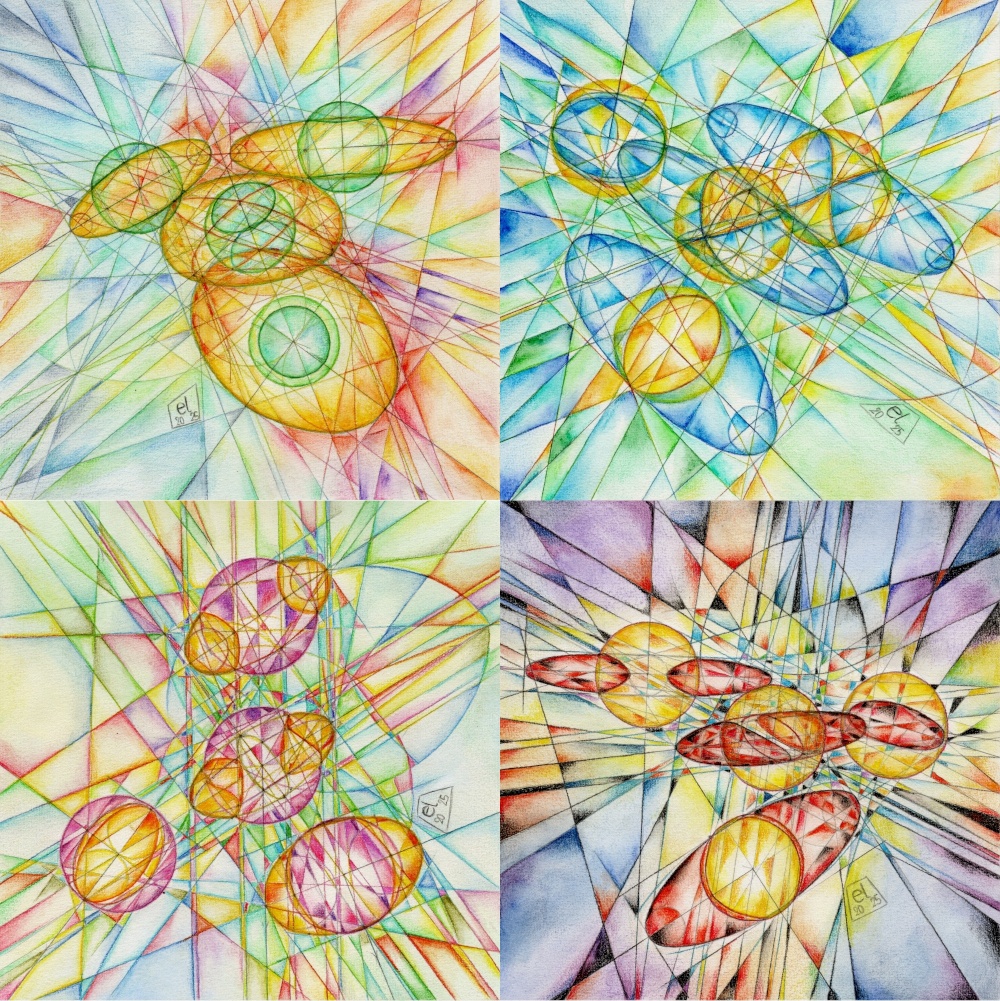
Poinsot’s Paper Spaceship (2025)
I’m presenting the recently completely series of artworks – and related physics blog posts – in its entirety! An ellipsoid is intersecting a sphere. Their intersection line is where the vector of angular momentum is seen to travel along – from the perspective of the spinning gyroscope. Four geometrical drawings, each based on the physics…
-

Poinsot’s Paper Spaceship #2 – Zeppelin: Unstable Rotation About the Intermediate Axis.
Subtitle: Why UFOs are more stable than zeppelins. This UFO… … tells a story of rotation. The yellow ellipsoid encapsulates the main features of a rotating rigid body: Its moments of inertia, that is: how masses are distributed in relation to three principal axes. The moment of inertia is larger, if more mass is positioned…
-

Poinsot’s Paper Spaceship #0 – The Plan
There was a time before computer-based three-dimensional visualization. There was a time before any software at all. When James Clark Maxwell sculpted thermodynamic functions with clay. When Louis Poinsot described the motion of the gyroscope in terms of three cones embracing each other, boiling down the essence of a free spinning top’s motion. Today, we…
-

Circles to Circles #6. The Making Of.
Number 6 is the last one in my series about stereographic projection! In this post, I am looking back at the creation of the whole series! It has started with messy sketches: How to fit the sphere and the circles onto a small sheet of A5 paper? How to make all six of them distinct…
-

Circles to Circles #5. Following the Rules.
Engineering is the art of creating solutions under constraints. The more rigid the constraints, the more creative you need to get. Art benefits from constraints, too. A long time ago, I discovered the joy of following – my own – silly rules when creating Found Poetry: Creating the labyrinth from which you want to escape.…
-

Circles to Circles – Digital Interlude
I wanted to know: How would it feel to replace ruler and compass with the straight lines and circle tools of drawing software? Procreate (the iPad drawing software) does not have anything like a compass. You cannot measure the length of a line segment either, or parallel transport lines exactly. You can create perfect circles…
-

Circles to Circles #2. A Friendly Death Star.
My art should speak for itself, as an abstract geometric drawing. But if you are so inclined, you can decode the math. Mathematics shows up twice: In the thing I am depicting, and in the techniques I am using to draw it geometrically. The series Circles of Circles is about stereographic projection of circles onto…
-

Circles to Circles #1. On Descriptive Geometry.
I am not a hoarder. I parted with school memorabilia long ago. When I started reading books on e-readers, the remaining books felt like an odd time capsule. They were not representing my reading self anymore. So, I got rid of most books, too. There was one exception: I still have my high school Descriptive…
-
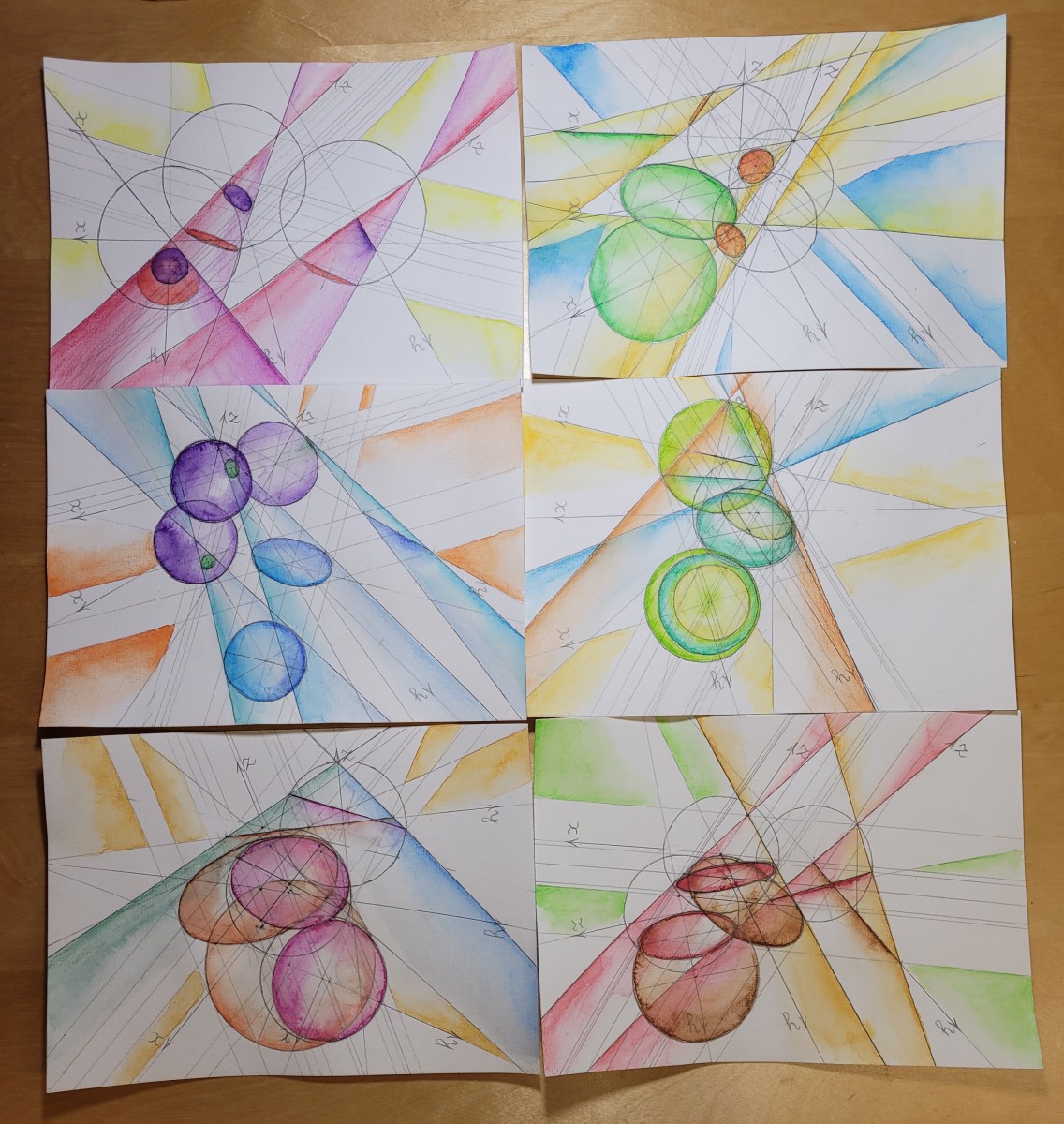
Circles to Circles – a Series in Progress
When I started creating mathematical artworks with code, the result was a series: I developed a virtual 3D sculpture, looked at it from different viewpoints with my virtual camera … and could not decide which “snapshot” I liked best. So, I panned and pivoted my camera and shot up about 10 different still images along…
-

Translucent Heart
Last year I’ve started drawing mathematical functions (relevant to physics), using traditional techniques of descriptive geometry. The very first test was an attempt to capture the three-dimensional Lissajous figure built from sin(t)/sin(2t)/sin(3t). Here is a blog post on the history of Lissajous in a Box! I’ve returned to it several times, and I ran out…