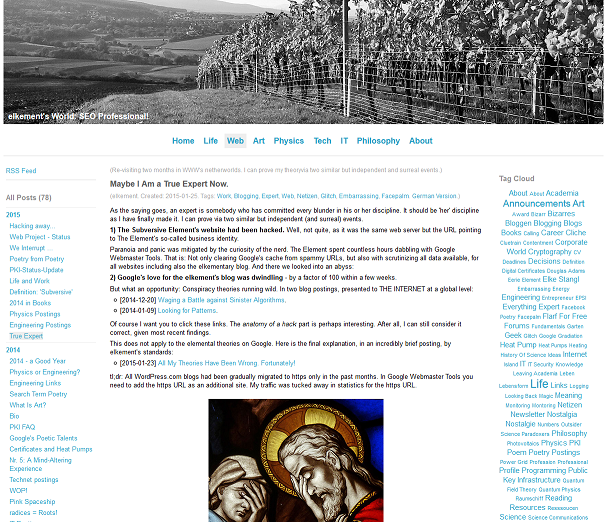
It’s nearly done (previous episode here).
I have copied all the content from my personal websites, painstakingly disentangling snippets of different ‘posts’ that were physically contained in the same ‘web page’, re-assigning existing images to them, add[someuorvvng tags, consolidating information that was stored in different places. Raking the Virtual Zen Garden – again. (Voice from the future – 2019: And I am at it again – this time I go for Grand Unification!)

… Nothing you have not seen in more elaborate fashion elsewhere. For me the pleasure is in creating the whole thing bottom up not using existing frameworks, content management systems or templates – requiring an FTP client and a text editor only.
I spent a lot of time on designing my redirect strategy. For historical reasons, all my sites use the same virtual web server. Different sites have been separated just by different virtual directories. So in order to display the [someurl] content as one stand-alone website, a viewer accessing [someurl] is redirected to [someurl]/e/. This means that entering [personal]/[business] would result in showing the business content at the personal URL. In order to prevent this, the main page generation script used checks for the virtual directory and redirects ‘bottom-up’ to [business.]/[business].
In the future, I am going to use a new hostname for my website. In addition, I want to have the option to migrate only some applications while keeping the others tied to the old ASP scripts temporarily. This means more redirect logic, especially as I want to test all the redirects. I have a non-public test site on the same server, but I have never tested redirects as it means creating loads of test host names; but due to the complexity of redirects to come I added names like wwwdummy for every domain, redirecting to my new main test host name, in the same way as the www URLs would redirect to my new public host name.
And lest we forget I am obsessed with keeping old URLs working. I don’t like it if websites are migrated to a new content management system, changing all the URLs. As I mentioned before, I already use ASP.NET Routing for having nice URLs with the new site: A request for /en/2014/10/29/some-post-title does not access a physical folder but the ‘flat-file database engine’ I wrote from scratch will search for the proper content text file based on a SQL string handed to it, retrieve attributes from both file name and file content, and display HTML content and attributes like title and thumbnail image properly.

The top menu, the tag cloud, the yearly/monthly/daily archives, the list of posts on the Home page, XML RSS Feed and XML sitemap are also created by querying these sets of files.

Now I want to redirect from the old .asp files (to be deleted from the server at some point in the future) to these nice URLs. My preferred solution for this class of redirects is using a rewrite map hard-coded in the web server’s config file. From my spreadsheet documentation of the 1:n relation of old ASP pages to new ‘posts’ I have automatically created the XML tags to be inserted in the ‘rewrite map’.
Now the boring part is over and I scared everybody off (But just in case you can find more technical information on the last update on the English version of the old new website, e.g. here) …
… I come up with my grand insights, click-bait X-Things-You-Need-To-Know-About-Seomthing-You-Should-Not-Do-and-Could-Not-Care-Less-Style:
It is sometimes painful to read really old content, like articles, manifestos and speeches from the last century. Yet I don’t hide or change anything.
After all, this is perhaps the point of such a website. I did not go online for the interaction (of social networks, clicks, likes, comments). Putting your thoughts out there, on the internet that does never forget, is like publishing a book you cannot un-publish. It is about holding yourself accountable and aiming at self-consistency.
I am not a visual person. If I would have been more courageous I’d use plain Courier New without formatting and images. Just for the fun of it, I tested adding dedicated images to each post and creating thumbnails from them – and I admit it adds to the content. Disturbing, that is!
I truly love software development. After a day of ‘professional’ software development (simulations re physics and engineering) I am still happy to plunge into this personal web development project. I realized programming is one of the few occupations that was part of any job I ever had. Years ago, soul-searching and preparing for the next career change, I rather figured the main common feature was teaching and know-how transfer – workshops and acedemic lectures etc. But I am relieved I gave that up; perhaps I just tried to live up to the expected ideal of the techie who will finally turn to a more managerial or at least ‘social’ role.
You can always find perfect rationales for irrational projects: Our web server had been hacked last year (ASP pages with spammy links put into some folders) and from backlinks in the network of spammy links I conclude that classical ASP pages had been targeted. My web server was then hosted on Windows 2003, as this time still fully supported. I made use of Parent Paths (../ relative URLs) which might have eased the hack. Now I am migrating to ASP.NET with the goal to turn off Classical ASP completely, and I already got rid of the Parent Paths requirement by editing the existing pages.
This website and my obsession with keeping the old stuff intact reflects my appreciation of The Existing – Being Creative With What You Have. Re-using my old images and articles feels like re-using our cellar as a water tank. Both of which are passions I might not share with too many people.
My websites had been an experiment in compartmentalizing my thinking and writing – ‘Personal’, ‘Science’, ‘Weird’, at the very beginning the latter two were authored pseudonymously – briefly. My wordpress.com blog has been one quick shot at Grand Unified Theory of my Blogging, and I could not prevent my personal websites to become more an more intertwined, too, in the past years. So finally both do reflect my reluctance of separating my personal and professional self.
My website is self-indulgent – in content and in meta-content. I realize that the technical features I have added are exactly what I need to browse my own stuff for myself, not necessarily what readers might expect or what is considered standard practice. One example is my preference for a three-pane design, and for that infinite (no dropdown-menu) archive.

Nothing slows a website down like social media integration. My text file management is for sure not the epitome of efficient programming, but I was flabbergasted by how fast it was to display nearly 150 posts at once – compared to the endless sending back and forth questionable stuff between social networks, tracking, and ad sites (watch the status bar!).
However, this gives me some ideas about the purpose of this blog versus the purpose of my website. Here, on the WordPress.com blog, I feel more challenged to write self-contained, complete, edited, shareable (?) articles – often based on extensive research and consolidation of our original(*) data (OK, there are exceptions, such as this post), whereas the personal website is more of a container of drafts and personal announcements. This also explains why the technical sections of my personal websites contain rather collections of links than full articles.
(*)Which is why I totally use my subversive sense of humour and turn into a nitpicking furious submitter of copyright complaints if somebody steals my articles published here, on the blog. However, I wonder how I’d react if somebody infringed my rights as the ‘web artist’ featured on my personal subversive website.
Since 15 years I spent a lot of time on (re-)organizing and categorizing my content. This blog has also been part of this initiative. That re-organization is what I like websites and blogs for – a place to play with structure and content, and their relationship. Again, doing this in public makes me holding myself accountable
Categories are weird – I believe they can only be done right with hindsight. Now all my websites, blogs, and social media profiles eventually use the same categories which have evolved naturally and are very unlike what I might have planned ‘theoretically’.
Structure should be light-weight. I started my websites with the idea of first and second level ‘menu’s and hardly any emphasis on time stamps. But your own persona and your ideas seem to be moving targets. I started commenting on my old articles, correcting or amending what I said (as I don’t delete, see above). subversiv.at has been my Art-from-the-Scrapyard-Weird-Experiments playground, before and in addition to the Art category here and over there I enjoyed commenting in English on German articles and vice versa. But the Temporal Structure, the Arrow of Time was stronger; so I finally made the structure more blog-like.
Curated lists … were most often just ‘posts’. I started collecting links, like resources for specific topics or my own posts written elsewhere, but after some time I did not considered them so useful any more. Perhaps somebody noticed that I have mothballed and hidden my Reading list and Physics Resources here (the latter moved to my ‘science site’ radices.net – URLs do still work of course). Again: The arrow of time wins!
I loved and I cursed the bilingual nature of all my sites. Cursed, because the old structure made it too obvious when the counter-part in the other language was ‘missing’; so it felt like a translation assignment. However, I don’t like translations. I am actually not even capable to really translate the spirit of my own posts. Sometimes I feel like writing in English, sometimes I feel like writing in German. Some days or weeks or months later I feel like reflecting in the same ideas, using the other language. Now I came up with that loose connection of an English and German article, referencing each other via a meta attribute, which results in an unobtrusive URL pointing to the other version.
Quantitative analysis helps to correct distorted views. I thought I wrote ‘so much’. But the tangle of posts and pages in the old sites obscured that actually the content translates to only 138 posts in German and 78 in English. Actually, I wrote in bursts, typically immediately before and after an important change, and the first main burst 2004/2005 was German-only. I think the numbers would have been higher had I given up on the menu-based approach earlier, and rather written a new, updated ‘post’ instead of adding infinitesimal amendments to the existing pseudo-static pages.
Analysing my own process of analysing puts me into this detached mode of thinking. I have shielded myself from social media timelines in the past weeks and tinkered with articles, content written long before somebody could have ‘shared’ it. I feel that it motivates me again to not care about things like word count (too long), target groups (weird mixture of armchair web psychology and technical content), and shareability.


Leave a Reply