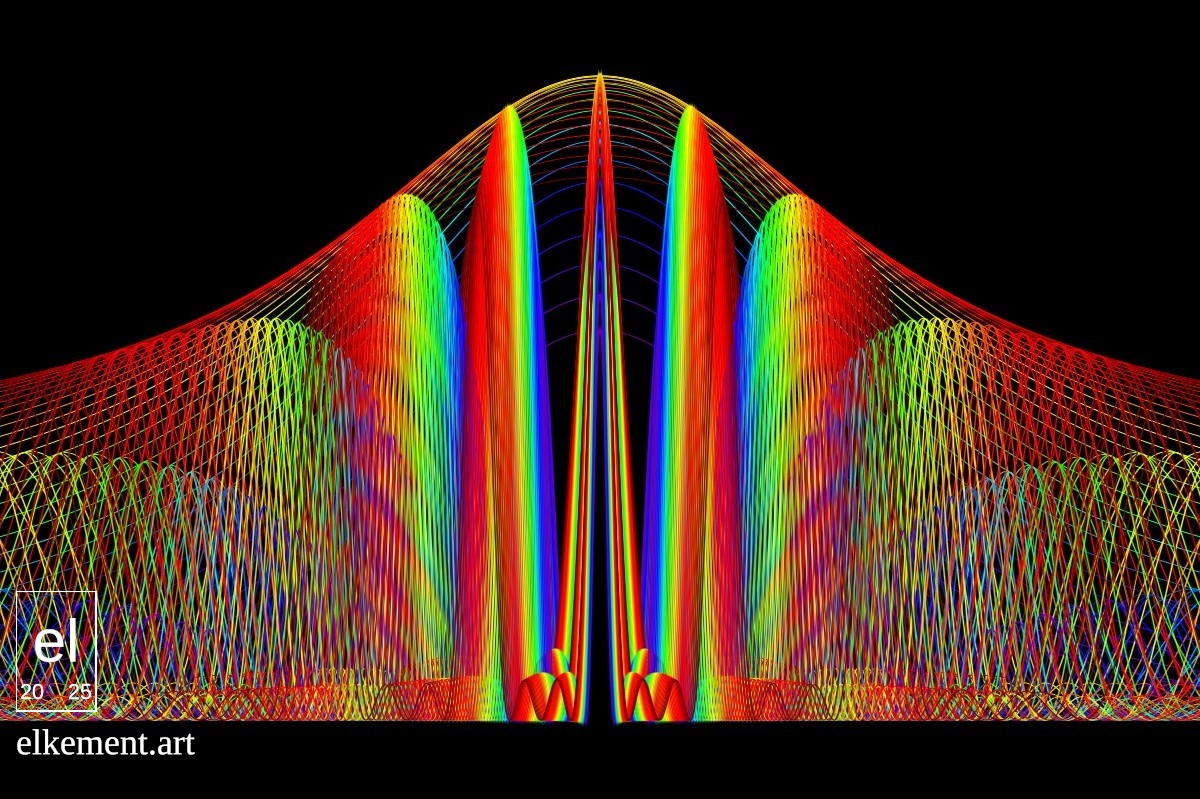
When you look at a streetlamp through a finely woven curtain diffraction patterns are registered at the retina of your eye.
When you look at the reflection of your reading light in your smartphone’s screen, diffraction happens.
Instead of a sharp image, you see a kaleidoscopic multitude of rainbow-colored overlapping, blurry images.
Each point of a grid becomes the origin of a wave of light, and all the elementary waves are interfering with each other. The resulting signal is strongest when the optical path difference corresponds to a multiple of two Pi. The more dots or lines the diffraction grating has, the less blurry the patterns are. Diffraction patterns of crystals examined with X-rays consist of sharp dots.
The distance of the structures in the diffraction pattern lets you calculate the distance of structures in the diffraction grating – their relationship is an “inverse” of sorts: The closer you pack the lines of the grid, the farther apart are the main peaks of the diffraction pattern.
Adding more and more dots and putting them closer and closer together finally produces a ribbon of tightly packed sources of light – the diffraction grating has become a single slit. It features a single main peak in the center. The narrower the slit, the wider is its diffraction pattern.
The intensity of light diffracted by an arrangement of slits is a combination of the characteristics of the diffraction grating and the single slit: The latter provides an enveloping curve to the series of sharper peaks caused by the former. If the slit is extremely narrow, the enveloping curve becomes very wide.
I had created lots of diffraction artworks in the past years: Each based on a hypothetical grating with a few slits. My latest static image created at the end of 2024 combined both code-generated art and a geometric drawing:

When I create my code art, I take a snapshot of a movie: I look at a 3D virtual sculpture, pivot and pan my camera.
This is now my first attempt to present a living stargate: In this purely 2D image I am just overlaying curves for different wavelengths (again weighted with the intensity of blackbody radiation – using a temperature a bit lower than that of the sun). Yet the dependence of the position of peaks on the wavelength make it appear three-dimensional.
These are several stargates: Patterns of 1,2,3, or 4 slits. The illusion of motion is caused by a gradual variation of the width of each slit and the distance of slits.
I’ve implemented this a fragment shader in WebGL – no vertex shader has been used to define the lines.
It was a very interesting experience that forced me to rethink “lines” from first principles, in contrast to the friendly software frameworks that let you create a line from A to B of a certain thickness. Here, I had to define my own line by calculating the perpendicular distance from my mathematical line – by calculating its derivative numerically – and let the color blur into the dark.
~
The original series created in 2022:


~

Leave a Reply