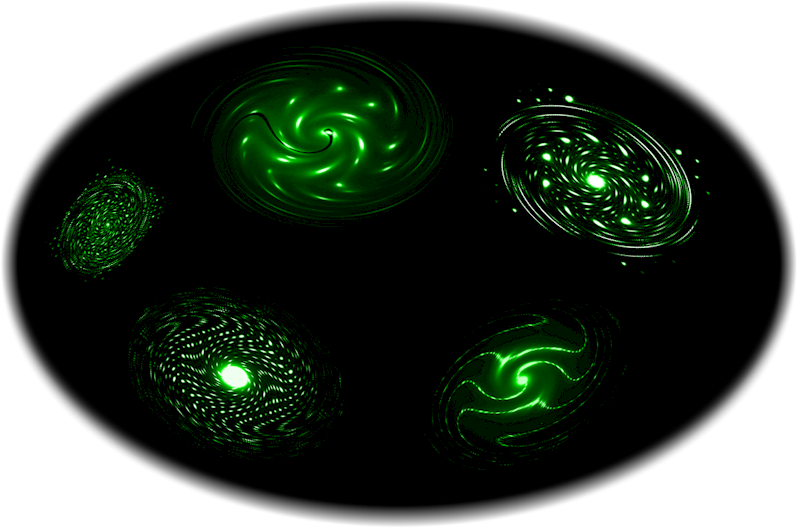
These – the arrangement of points in the image below – are covectors, sort of. I wrote about them, some time ago. They are entities dual to vectors. Eating vectors, spitting out numbers. Vectors are again ‘co’ to vectors; they will eat covectors.
If vectors live in a space with axes all perpendicular to each other, the conceptional difference between vectors and co-vectors is obscured. They all seem to live in the same space. A co-vector is like a set of parallel planes, but you could also think of the ‘normal vector’ perpendicular to these planes.

Each image is an electron diffraction pattern – the two-dimensional projection of a lattice dual to the arrangement of the atoms in the crystal analyzed. This can be phrased in many ways. The diffraction pattern is the Fourier Transform of the physical crystal. The Direct Lattice is made up of spatial distances in physical space. It is dual to the Reciprocal Lattice, which is made up of wave vectors. Wave vectors point along the normal vector to sets of crystal lattice planes, and their lengths represents spatial frequencies – inversely proportional to wavelengths. Different wave vectors (sets of parallel planes in the crystal) translate to different angles on the image – angles between the direction of the incoming beam (perpendicular to the image plane), and the outgoing beam that will create a point on the image. The pattern is generated by summing up all the wavelets of which the wavefront hitting the crystal is made of (Huygens’ Principle). All this can be traced down to the linearity of Maxwell’s Equations: You can add up homogeneous solutions of the wave equations for the electric and magnetic fields. These solutions are the wavelets or the Fourier components.

I had analyzed such patterns created by an electron microscope, a long time ago. In a world that feels like a different galaxy now …
… No software, no image recognition. You measured the distances of points in the image, and looked up sample patterns stored in a large cabinet with many drawers, like a large card index box. Then I was in charge of replacing the vintage cabinet by software running on DOS. The software was faster, but its user interface was forbidding. The box – made of wood and metal – was steampunk and nice to work with.
~~~
Sources for diffraction patterns: Wikimedia, public domain or ‘share-alike’ license, attribution in hover text / links below. (I guess that means I share my ‘collages’ under the most restrictive of the share-alike licenses mentioned. Or is my elliptical universe of galaxies such a ‘transformative piece of art’ that I would not even need attribution?)


Patterns have been distorted by a 180° ‘vortex’ to yield ‘galaxies’. I have remembered these images as beautiful – and the related ‘analog’ work as meditative. It is difficult to convey this beauty in an era of impeccable three-dimensional renderings in science videos. Therefore, the galaxies are colored in early-monochrome-display-green, indicating the era.


Leave a Reply