Peter von Rittinger’s biography reads like a Victorian novel, and his invention was a text-book example of innovation triggered by scarcity.
Born 1811, he was poor and became an orphan early. Yet he was able to study mathematics and physics as his secondary education had been financed by the Piarist Order. He also studied law and mining. Immediately after having graduated he was appointed as inspector in an iron ore processing plant (stamping mill), and later called a pioneer in that field and accountable for several inventions.
1850 Rittinger became ‘Sectionsrat’ (head of a division) in the Ministry of Agriculture and Mining in Vienna. He was knighted in 1863, so quoting all his titles as a public servant in the higher echelons of the Austro-Hungarian empire he was: k. k. Sectionsrath Oberbergrath Ritter von Rittinger. (Detailed biographies: DE / EN).

Yet it seems even as an administrator he was still a hands-on tinkerer. He developed a process for harvesting salt from brine at Saline Ebensee in Upper Austria – saving 80% of input energy compared to other processes used at this time.
In the mid of the 19th century saltworks in Austria had been dependent on wood available locally. Having cut down forests, they ran out of fuel. Railway tracks have not been built yet, and fossil fuels had not yet been available. The ecological footprint had to be much closer to the physical area than today.
But Sectionsrath Rittinger was creative with what was available. In History of Heatpumps, Martin Zogg writes:
One of the main applications [of mechanical vapor compression] is the salt production from salt brine. In order to get 1 kg of salt there have to be evaporated about 3 kg of water, which illustrates the enormous energy demand of such processes. Whole forests had been cleared for this purpose.
Peter von Rittinger … was the first to try the realisation of this idea on a pilot scale. …. He designed and installed the first known pilot heat pump for heating only with a capacity of 14 kW, … The start-up of Rittinger’s “steam pump” was in 1857.
This is the title page of Rittinger’s publication of 1855:

Translating about to:
Theoretical-practical treatise
on a novel evaporation process
applicable to all varieties of liquids
using one and the same amount of heat
which – for this purpose –
is set into perpetual circular motion by water power.
Taking into account the salt boiling process specifically.
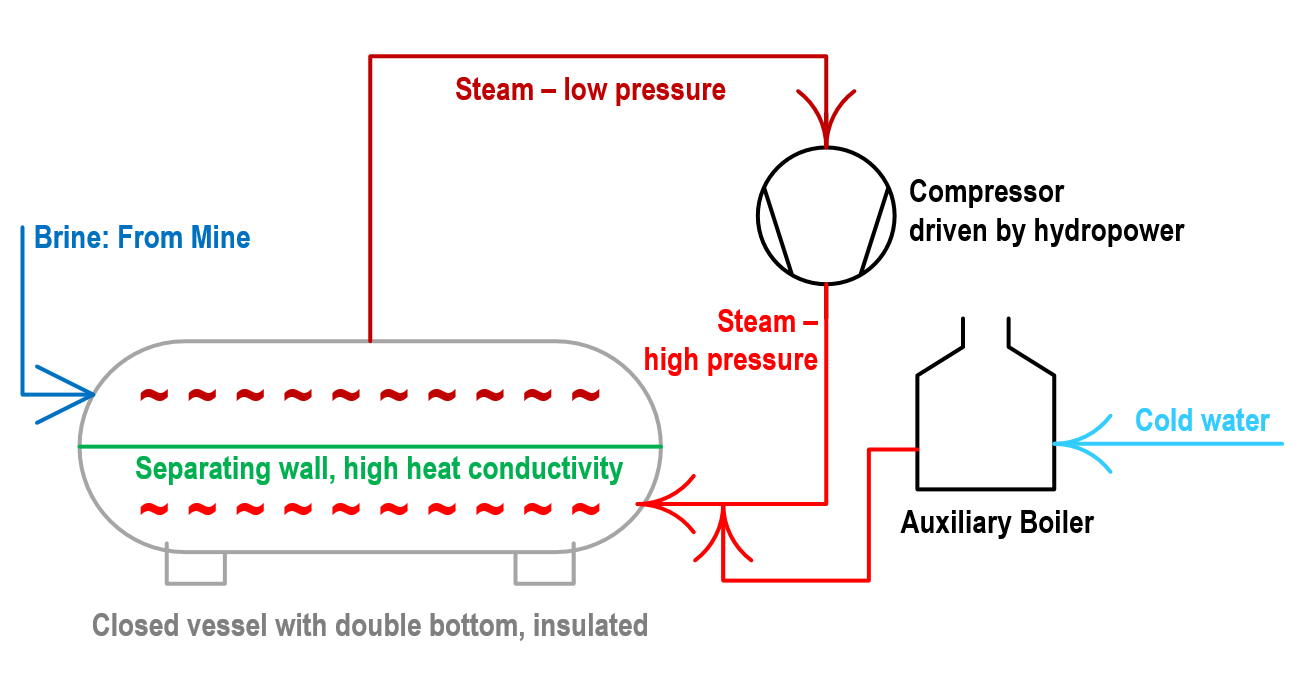
I have created this simplified figure from the description in his paper:

Salt brine is feed into the upper part of a vessel – which can be closed and has two parts: The colder, upper part contains brine mixed with water vapor at low temperature and low pressure; the lower part is separated from this cavity by a metal slab with high thermal conductivity. The colder vapor is compressed; and the compressor is driven by a water wheel. To start the process, all cavities are filled with vapor heated to 100°C at the beginning.
At a higher pressure, the evaporation / condensation temperature is higher. Thus hot, dense vapor condenses on the top of the lower cavity, releasing heat which is available in the upper cavity to heat the colder ‘input vapor’. This makes salt precipitate in the upper chamber where it was collected regularly.
In a heat pump for room heating a refrigerant running in a closed cycle is compressed by a mechanical compressor powered by electrical energy. At low temperatures and low pressures the refrigerant evaporates easily, even when in contact with a cold heat source (such as our water / ice tank at 0°C in winter). After compression, vapor condenses at temperatures higher than room temperature and thus the refrigerant is able to release the heat ‘harvested’ before. Rittinger’s steam pump is called The First Heat Pump by historians: However, in this device the water vapor mixed with salt brine is both the ‘refrigerant’ and the liquid to be heated!
In his paper, Rittinger explained that you could as well start from a brine at a temperature as low as 10°C, not needing any auxiliary heating. The system would operate at lower temperatures and pressures. But due to the lower pressures the same material would occupy a larger volume and thus the system had to be much bigger. I suppose, taking into account investment costs, this would have been less economical than using a bit of fuel to get the process going.
What I found intriguing about Rittinger’s work – and perhaps about the way research publications were written back then – was the combination of hands-on engineering, theoretical modeling, and honest and ‘narrative’ reporting of difficulties. Zogg’s history of heat pump quotes quite a number of Leonardo-da-Vinci-style inventors with diverse interests and an obviously ‘holistic’ approach.
Martin Zogg notes that using today’s technology, such ‘steam pumps’ easily obtain a coefficient of performance of 15 – more than 3 times the COP of a heat pump used for room heating. Mechanical vapor compression is state-of-the art technology in salt processing. The reason for the high COP is the lower temperature difference between hot and cool brine vapor. You just need to provide for a sufficient temperature gradient to allow for heat transport from the hot to the cooler cavity, and to overcome the change in evaporation temperature (according to Raoult’s Law).
I could not find the figures in the original paper that Rittinger referred to. The following image is a link to a clickable, larger version of the figures Rittinger had added to a later paper dated 1857, on the actual results of his experiments. Its title was: Darstellung der zu Ebensee abgeführten Versuche über die Reproducirung der im Wasserdampf gebundenen Wärme durch Wasserkraft behufs ihrer Verwendung zum Abdampfen der Salzsoole.
At the time of writing this article, Rittinger’s 1857 paper was at dingler.culture.hu-berlin.de/article/pj146/ar146042. In 2022 this link is (currently?) broken, connection to dingler.culture.hu-berlin.de times out. This web page was provided by digitized archive of Polytechnisches Journal, by University of Berlin, and it also an ‘interactive map’ allowing for zooming in on parts of the construction.
In 2022, some of the images are still in the Google Cache. I also noticed that these images and the links have been shared on social media after I had published this blog post in 2015. I was able to salvage one higher resolution image to which this thumbnail links now (after the original link to dingler.culture.hu-berlin.de broke).

What looks like a top view of spaceship Enterprise is the vessel seen from the top. On the left, the corresponding side view shows that it was rather tall. What had been described as a simple separating wall-style flat heat exchanger was actually built as a system of several cylindrical cavities (to increase the heat exchanger’s surface). In the figure the cavities containing high-pressure vapor are denoted with b/c/d. The steam pump / compressor is denoted with E, Dampf-Pumpe, and shown to the right of the vessel in the side view.
Though the numbers were in line with his theoretical calculations, Rittinger’s pilot system did not work well: This was an unreliable batch process, as the vessel was opened regularly to remove the precipitated salt. Rittinger made some suggestions in his original paper, on how to harvest salt continuously. From experience he knew that salt crystals should easily glide downwards from a tilted plane. But among other issues, Rittinger noted in his research report from 1857 that salt crystals behaved quite differently in his vessel, and he attributed it to the higher temperatures in the closed vessel: Instead of being able to harvest the loose crystal at the tip of the conical vessel, all vertical planes have been covered with a crust of salt that resisted also the strongest chisel.
His epigones finally solved such issues – quoting Zogg again:
Probably stimulated by the experiments of Rittinger at Ebensee, the first truly functioning vapour recompression salt plant was developed in Switzerland by Antoine-Paul Piccard the University of Lausanne and the engineer J.H. Weibel of the company Weibel-Briquet of Geneva in 1876. In 1877, this first heat pump in Switzerland was installed at the salt works at Bex. It was on a larger scale than Rittinger’s apparatus and produced around 175 kg/h of salt in continuous operation.
This images shows a historical piston compressor, installed 1878 in the salt mine of Bex, Switzerland (Wikimedia, public domain, from Martin Zogg’s History of Heat Pumps). 1943 it was still in operation!


Leave a Reply