Chances are I made a fool of myself when trying to solve an intriguing math/physics puzzle described in this post.
I wanted to create a German version but found it needs a revision. I will just give you my stream of consciousness as I cannot make it worse anyway.
The puzzle presented by Quantum Boffin in this video is presented as a ‘physics puzzle’ but I think its enigmatic nature is described better if stated in purely mathematical terms:
Consider three lines in a flat plane, not parallel to each other and not intersecting in a single point. Their mutual intersection points are the corners of a triangle.
Assuming that the probability to find an arbitrary point on either side of each line is 50% – what is the probability to find a point within the triangle?
I had proposed a solution of 1/7. My earlier line of reasoning was this:
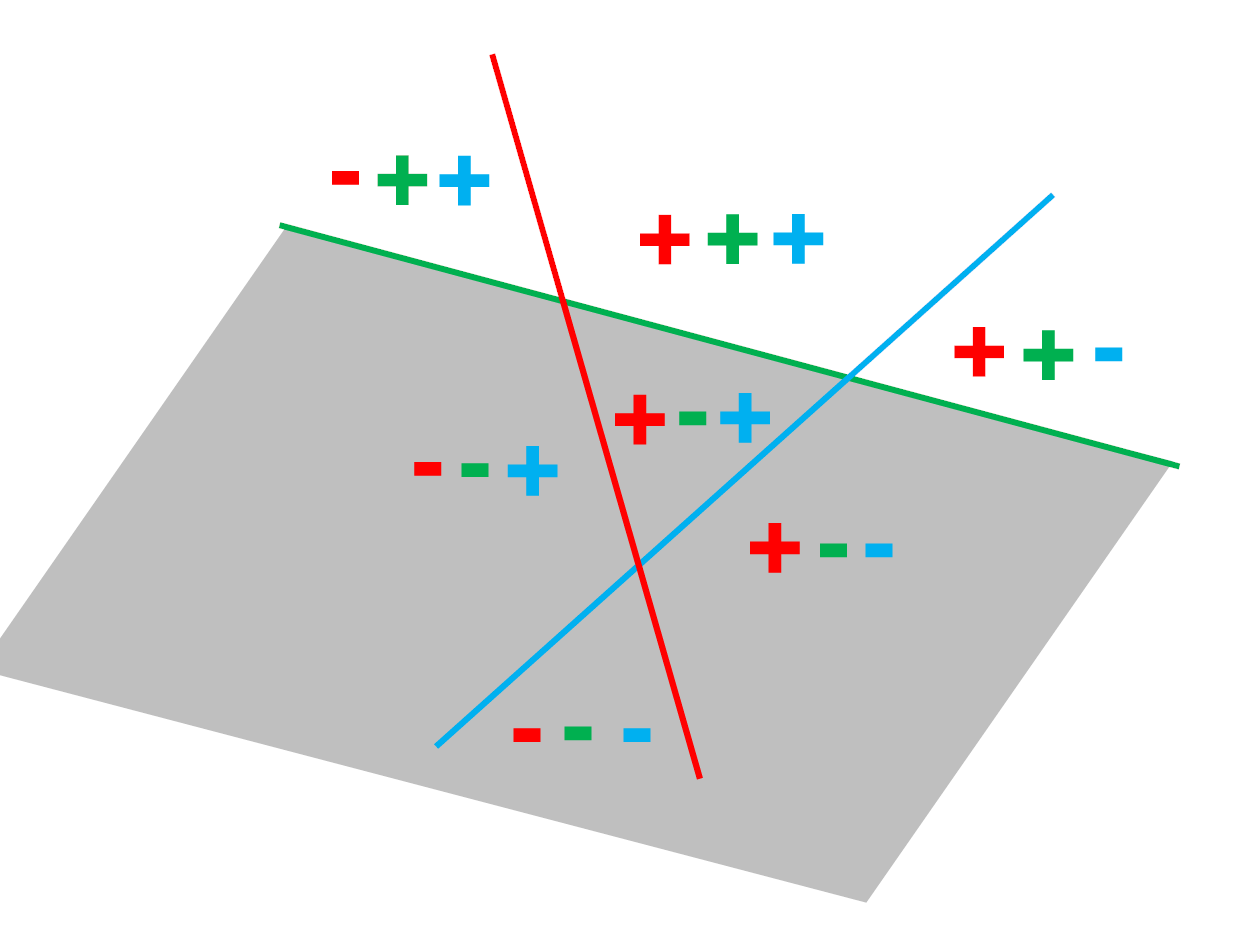
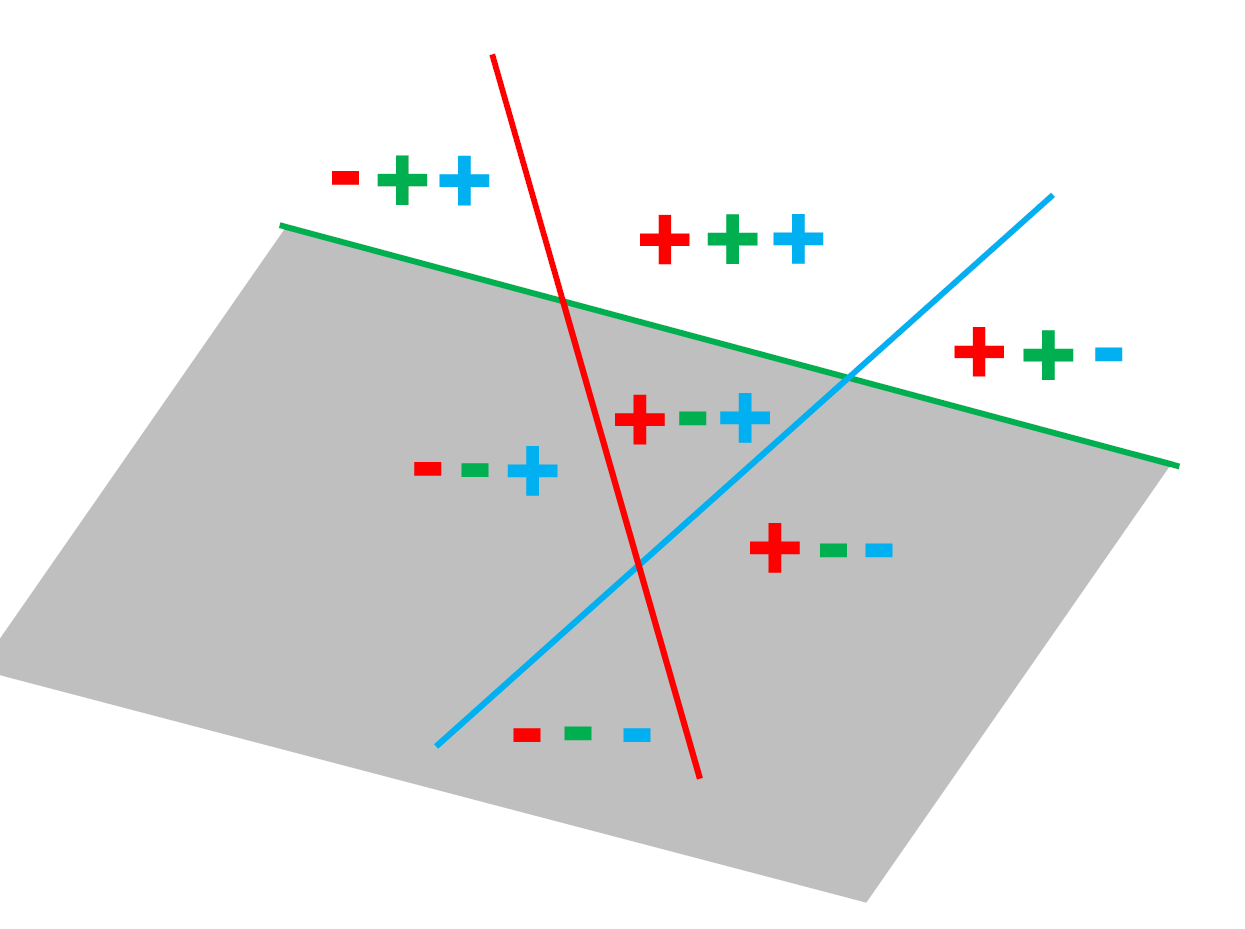
The three lines divide the full area into 7 parts – the triangle in the center and 6 sections adjacent to the triangle: Each of these parts is located either ‘to the left’ or ‘to the right’ of each line, called the ‘+’ and ‘-’ parts.

There are 8 possible combinations of + and – signs, but note that the inverse of the symbols assigned to the triangle is missing: (-+-) Digression: It would be there if we painted these lines on a ball instead of a flat plane – then each line would close on itself in a circle and there would be 8 equivalent triangles. The combination missing here would correspond to the triangle opposite to the distinguished and singular triangle in our flat plane.
I had assumed that the 7 areas are equivalent based on ‘symmetry’ – each area being positioned on either side of one of three planes – and assuming that the condition given (50%) is not physical anyway. A physical probability would vary with distance from the line – imagine something like a Gaussian symmetrical distribution function centered around each line. Than the triangle would approximately correspond to the area of highest probability (where the peaks of the three Gaussians overlap most).
Do you spot the flaw?
We can do two cross-checks:
1) the sum of the probabilities of all parts should add up to 1 – OK as 7 x 1/7 is 1. But :
2) the sum of probabilities of all pieces on either side of a line should add up to 0,5! This was the assumption after all.
Probabilities don’t add up correctly if I assign the same probability to each of the 7 pieces – it is 4/7 for the lower half and 3/7 for the upper half.
So I need to amend my theory and rethink the probability assigned to different kinds of areas (I guess mathematicians have a better term for ‘kinds of areas’ – more like ‘topologically equivalent’ or something.).
We spot three distinct shapes:
- A triangle formed by the three lines.
- Three ‘open wedges’ formed by two lines – e.g. part (- – -) in the lower half.
- Three ‘open trapezoids’ formed by three lines, e.g. part (+++) in the upper half.
I am assuming now that probabilities assigned to all wedges are the same and those assigned to trapezoids are the same. I am aware of the fact that this will not work out if we consider a limiting case: Assume the angle between two of the three lines gets smaller and smaller – this will result in one very small wedge (between the red and the blue line) and two ‘wedges’ which are nearly equivalent to a quarter of the total area:

In the limiting case of the blue and red lines coalescing we would end up with four quarters, and you would find an arbitrary point with a probability of 25% in either quarter.
In the video Quantum Boffin has asked for the probability of the triangle – which can be any triangle, of any arbitrary shape and size, and he states that there is a definitive answer. Therefore I think also the details of size and shape of the other areas do not matter, and the 50% assumption is somewhat unphysical.
As there are three distinct types of shapes – I need three equations to calculate them all.
Notation in the following: p… probability. T…triangle, W…wedge, Z…trapezoid. p(T) denotes the probability to find a point in the triangle.
The sum of all probalities to meet the point in either of the 7 pieces must be 1, and we have 3 wedges and 3 trapezoids:
i) p(T) + 3p(W) +3p(Z) = 1
We need 50% on either side of a line.
There is one Z and 2W on one side…
ii) p(Z) + 2p(W) = 0,5
…and T and 2W on the other side:
iii) p(T) + 2p(Z) + p(W) = 0,5
Now the sum ii) and iii) is just i) that these equations are not independent. We need one more information to solve for p(T), p(W), and p(Z)!
And here is my great educated guess: You have to make another assumption and this has to be based on a limiting case. How else could we make an assumption for an arbitrary shape?
I played with different ones, such as letting iv) p(W) = 0,25 motivated by the limiting case of a nearly right angle. Interestingly, you obtain a self-consistent solution. Just plugging in and solving you get: p(T)=0,25 and p(Z)=0. Cross-checking you see immediately that this is consistent with the assumptions – probabilities sum of to 50%: You either have two Ws or one W and the T in one half of the plane.
Assigning 0 to the trapezoid does not seem physical though. We can do better.
So what about assigning equal probabilities to Z and W? iv) p(Z) = p(W)?
I don’t need to do the algebra to see that p(T) has to be zero as you would have 3 equivalent pieces on each side, but the triangle can only be located one one side.
This assumption is in line with the limiting case of a really infinite plane. The triangle has finite size compared to 6 other infinite areas.
I change my proposal to: The probability to find an arbitrary point in the triangle is zero – given the probability to find it on either side of each line is 50% and given that the area is infinite.
Again I’d like to stress that I consider this a math puzzle as the 50% assumption does not make sense without considering a spatial variation of probability (probability density, actually).
Addition as per November 21:
Based on the ingenious proposal by Jacques Pienaar in the comments, I am adding a sketch highlighting his idea.
Theoretically, the center of mass would correspond to the intersection of the 3 “perfect” solid lines. Now allow for some “measurement error” and add an additional line denoting the deviations. I depicted the “left” and “right” lines as dashed and dotted, respectively.
Now take a break, get a coffee, and look at the position of the true center of mass with respect to the triangles made up by the dashed and dotted lines:

Since we have 3 colors and either a dashed or a dotted lines, there are 8 distinct triangles. I tried to make the angles and distances as random as possible, so I think Jacques’ proof does not depend on the details of the configuration or the probability distribution function (yet beware the limiting cases such as parallel lines). The intersection of the solid lines is within 2 of 8 triangles – hence a probability of 2/8 = 1/4.
I was intrigued by an odd coincidence as I had played with 0,25, too (see above), but based on the assumption that of a probability of 0,25 for the wedges/corners – which by cranking the algebra or just cross-checking the 50% criterion results in p(Triangle)=0,25, too, and in p(Trapezoid)=0.
Looking hard at this new figure introduced by Jacques I see something closely related, but unfortunately a new puzzle as well: The true center of mass is in exactly two of eight trapezoids built from dashed or dotted lines. So I am tempted to state:
p(Trapezoid)=0,25.
But it is difficult to make a statement on the corners or wedges as any intersecting two lines cut the plane in 4 parts and any point is found in one of them. I was tempted to pick p(W) = 0 though, but this would result in p(Triangle)= -0,25.
So this was probably not the last update or the last post related to the enigma of the intersecting lines.


Leave a Reply