Tag: Mathematics
-
Integrating The Delta Function (Again and Again) – Penrose Version
I quoted Nobel prize winner Paul Dirac’s book, now I will quote this year’s physics Nobel prize winner Roger Penrose. In his book The Road to Reality Penrose discusses not-so-well-behaved functions like the Delta Function: They belong in the category of Hyperfunctions. A Hyperfunction is the difference of two complex functions: Each of the complex…
-

The RSA Algorithm
You want this: Encrypt a message to somebody else – using information that is publicly available. Somebody else should then be able to decrypt the message, using only information they have; nobody else should be able to read this information. The public key cryptography algorithm RSA does achieve this. This article is my way of…
-

Integrating the Delta Function (Again) – Dirac Version
The Delta Function is, roughly speaking, shaped like an infinitely tall and infinitely thin needle. It’s discovery – or invention – is commonly attributed to Paul Dirac[*]. Dirac needed a function like this to work with integrals that are common on quantum mechanics, a generalization of a matrix that has 1’s in the diagonal and…
-

Delta Function Haiku
I have proved that a Lorentzian bell curve becomes the Dirac Delta Function in the limit. Now I want to look at another representation of the Delta Function. As this is a shorter proof, a haiku will do. ~ Infinite numbers of oscillations added. Need to damp them down Symmetrically attach an exponential for each…
-
The Improper Function and the Poetry of Proofs
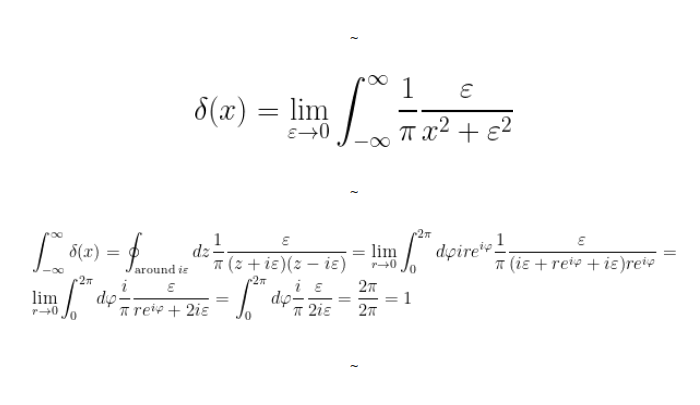
Later the Delta Function was named after their founder. Dirac himself called it an improper function. This time, the poem is not from repurposed snippets of his prose. These are just my own words to describe a proof: ~ In the limit the Lorentzian becomes the improper function. In the limit of tiny epsilons it…
-

Heat Conduction Cheat Sheet
I am dumping some equations here I need now and then! The sections about 3-dimensional temperature waves summarize what is described at length in the second part of this post. Temperature waves are interesting for simulating yearly and daily oscillations in the temperature below the surface of the earth or near wall/floor of our ice/water…
-

Tinkering, Science, and (Not) Sharing It
I stumbled upon this research paper called PVC polyhedra: We describe how to construct a dodecahedron, tetrahedron, cube, and octahedron out of pvc pipes using standard fittings. … In particular, if we take a connector that takes three pipes each at 120 degree angles from the others (this is called a “true wye”) and we…
-

Heat Transport: What I Wrote So Far.
Don’t worry, The Subversive Elkement will publish the usual silly summer posting soon! Now am just tying up loose ends. In the next months I will keep writing about heat transport: Detailed simulations versus maverick’s rules of thumb, numerical solutions versus insights from the few things you can solve analytically, and applications to our heat…
-
Spheres in a Space with Trillions of Dimensions
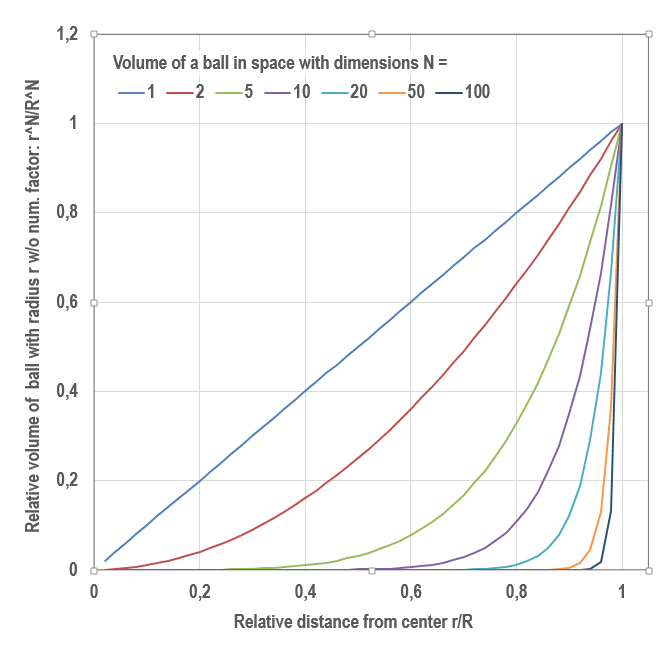
I don’t venture into speculative science writing – this is just about classical statistical mechanics; actually about a special mathematical aspect. It was one of the things I found particularly intriguing in my first encounters with statistical mechanics and thermodynamics a long time ago – a curious feature of volumes. I was mulling upon how…
-

Ploughing Through Theoretical Physics Textbooks Is Therapeutic
And finally science confirms it, in a sense. Again and again, I’ve harping on this pet theory of mine: At the peak of my immersion in the so-called corporate world, as a super-busy bonus miles-collecting consultant, I turned to the only solace: Getting up (even) earlier, and starting to re-read all my old mathematics and…
-

Simulating Peak Ice
This year ice in the tank was finally melted between March 5 to March 10 – as ‘visual inspection’ showed. Level sensor Mr. Bubble was confused during the melting phase; thus it was an interesting exercise to compare simulations to measurements. Simulations use the measured ambient temperature and solar radiation as an input, data points…
-
Learning General Relativity
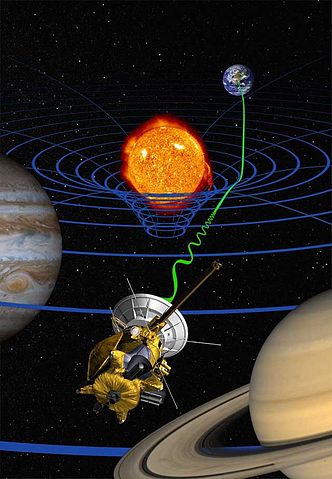
Math blogger Joseph Nebus does another A – Z series of posts, explaining technical terms in mathematics. He asked readers for their favorite pick of things to be covered in this series, and I came up with General Covariance. Which he laid out in this post – in his signature style, using neither equations nor…
-

Rowboats, Laser Pulses, and Heat Energy (Boring Title: Dimensional Analysis)
Dimensional analysis means to understand the essentials of a phenomenon in physics and to calculate characteristic numbers – without solving the underlying, often complex, differential equation. The theory of fluid dynamics is full of interesting dimensionless numbers – Reynolds Number is perhaps most famous. In the previous post on temperature waves I solved the Heat…
-
Temperature Waves and Geothermal Energy
Nearly all of renewable energy exploited today is, in a sense, solar energy. Photovoltaic cells convert solar radiation into electricity, solar thermal collectors heat hot water. Plants need solar power for photosynthesis, for ‘creating biomass’. The motion of water and air is influenced by the forces caused by the earth’s rotation, but by temperature gradients…
-

How to Evaluate a Heat Pump’s Performance?
The straight-forward way is to read off two energy values at the end of a period – day, month, or season: The Seasonal Performance Factor (SPF) is the ratio of these – the factor the input electrical energy is ‘multiplied with’ to yield heating energy. The difference between these two energies is supplied by the…
-

Gödel, Escher, Bach, and Strange Loops: Nostalgia and Random Thoughts
I am curious – who read the book, too? Did you like it? I read it nearly 30 years ago and I would also tag it one of the most influential books I read as a teenager. [This might grow into a meandering and lengthy post with different (meta-)levels – given the subject of the post I…
-

In Praise of Textbooks with Tons of Formulas (or: The Joy of Firefighting)
I know. I am repeating myself. Maurice Barry has not only recommended Kahneman’s Thinking, Fast and Slow to me, but he also runs an interesting series of posts on his eLearning blog. These got mixed and entangled in my mind, and I cannot help but returning to that pet topic of mine. First, some statistically…
-

Mastering Geometry is a Lost Art
I am trying to learn Quantum Field Theory the hard way: Alone and from textbooks. But there is something harder than the abstract math of advanced quantum physics: You can aim at comprehending ancient texts on physics. If you are an accomplished physicist, chemist or engineer – try to understand Sadi Carnot’s reasoning that was…